
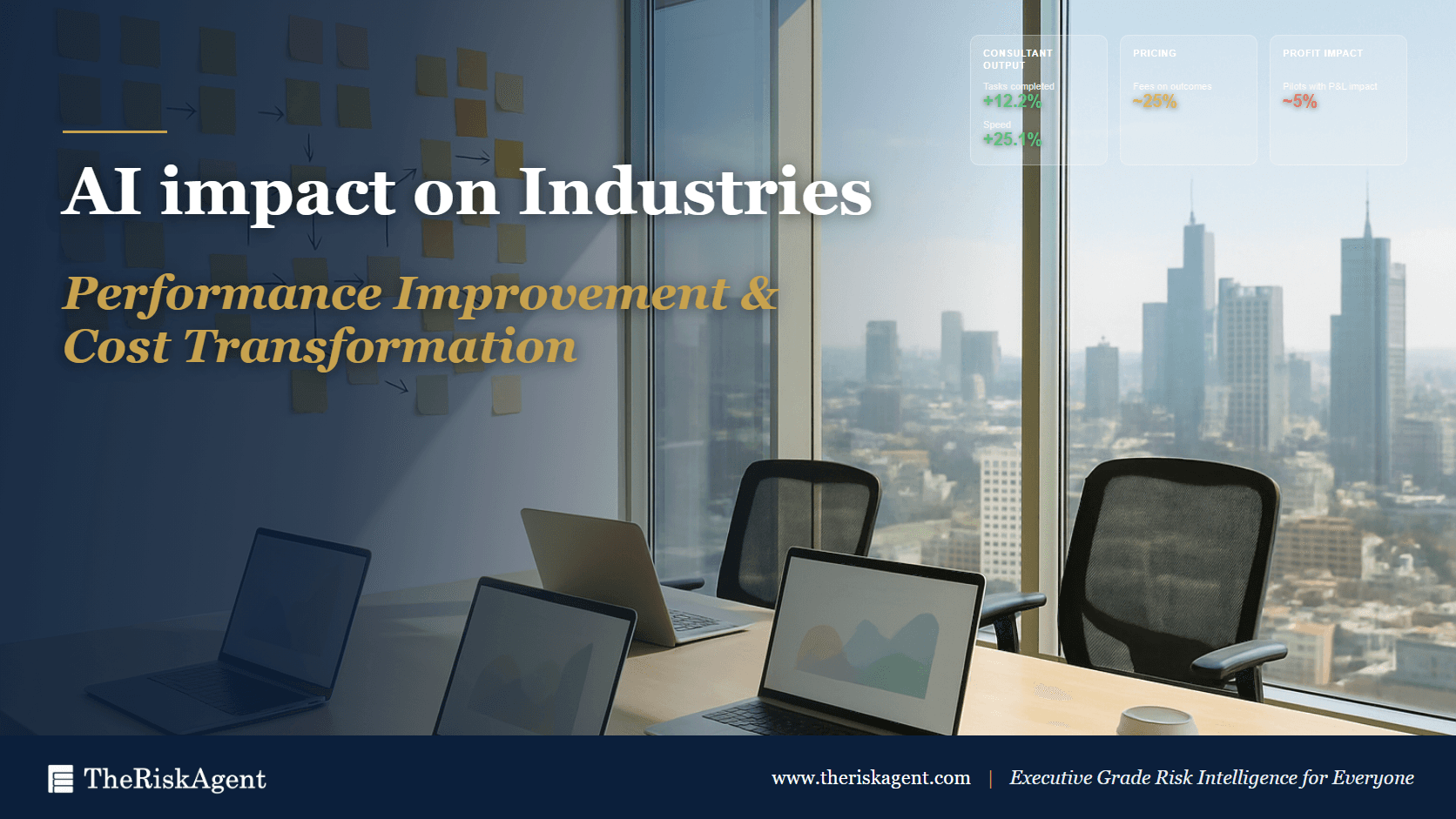

AI's impact on the global performance improvement and cost transformation industry, assessed as at 19 October 2026.
Concern about what artificial intelligence is doing to the consulting business no longer rests on forecasts. In the first half of October 2026, Analysys Mason bought the Swedish AI consultancy Modulai and its roughly 35 engineers, Accordion bought the agentic-engineering firm Stride and its roughly 50 forward-deployed engineers, Andersen closed four consulting acquisitions in AI, cyber and digital transformation, and Bowman Consulting bought the geospatial-AI firm dymaptic. Each buyer paid for people who build AI systems rather than people who advise on them.
At first sight AI is a growth market for firms that sell performance improvement and cost transformation. Every client wants its costs cut, and AI is the newest tool for cutting them.
What the industry sells, however, is now itself the cost being cut. Consulting has been sold for decades as analytical hours, most of them supplied by junior staff at the base of a pyramid. In a controlled experiment with 758 Boston Consulting Group consultants, those given AI completed 12.2 per cent more tasks, 25.1 per cent faster and at over 40 per cent higher quality on work within the tool's reach. When the work that fills the hours shrinks, so does the thing the client was billed for.
The largest firms are responding by moving fees from hours to results. That protects revenue, but it moves the risk of AI disappointing from the client to the adviser, in an economy where most AI pilots still show no measurable profit. Advisers who promise savings are increasingly paid only when those savings land.
Five AI risks for performance improvement and cost transformation firms, ranked by how hard they bite
1. Selling outcomes on a technology that mostly fails to pay. Most enterprise AI pilots have yet to pay back, and abandonment is rising. Under outcome-based or variable fees, a pilot that never reaches the profit-and-loss account is no longer only the client's disappointment; it is an unbilled engagement for the firm that designed it.
2. The economics of the pyramid giving way. The consulting pyramid, in which partners sold the time of many junior analysts at a mark-up, depends on hours that AI now compresses. Firms that still earn by the head carry the steepest margin and valuation risk.
3. A bench that can no longer catch the machine. Automating the junior work also removes the apprenticeship that built the judgement needed to catch an AI error.
4. Liability for AI-assisted advice. A consultancy cannot hand its duty of care to a model: when AI-assisted advice causes a client loss, the firm answers for it.
5. The knowledge platform as an attack surface. The internal AI platforms that hold a firm's methods and client work are a new entry point. A breach that alters how such a platform reasons, rather than one that steals data, would deliver corrupted advice under the firm's own name. This risk is the least likely of the five, but the hardest to detect.
AI's productivity gain in consulting is proven; the profit is not
The productivity evidence is unusually strong for a professional service. The Harvard Business School and BCG field experiment tested consultants on realistic tasks with and without AI, and the gains on work inside the tool's capability were large on every measure. Large firms report the same pattern in daily use: McKinsey's internal knowledge platform, Lilli, is used each month by more than 70 per cent of its staff and handles over 500,000 prompts a month.
Profit is a different story. MIT's Project NANDA found that about 95 per cent of generative AI pilots delivered no measurable impact on the profit-and-loss account. That figure carries caveats: the work was preliminary, not peer-reviewed, relied on self-reported data and counted as failure anything without measurable impact inside roughly six months. Other evidence points the same way. An IBM Institute for Business Value study of chief executives found that only about a quarter of AI initiatives had delivered the return expected, and about 16 per cent had scaled across the enterprise.
The failures are organisational rather than technical. The NANDA work traced the shortfall to how organisations put the tools to work, not to the quality of the models. Tools bought from specialist vendors succeeded about 67 per cent of the time, well above systems built in-house, and projects aimed at repetitive back-office processes succeeded far more often than generic tools pointed at sales and marketing. Back-office process is precisely the territory that cost-transformation firms sell.
| Measure | Result | What it measures |
|---|---|---|
| Consultants with AI: tasks completed | +12.2% | Controlled experiment, 758 BCG consultants, tasks within the tool's reach |
| Consultants with AI: speed | 25.1% faster | Same experiment |
| Consultants with AI: quality | Over 40% higher | Same experiment |
| Generative AI pilots with measurable P&L impact | About 5% | MIT Project NANDA; preliminary, self-reported, six-month window |
| AI initiatives delivering the return CEOs expected | About 25% | IBM Institute for Business Value CEO study |
| AI initiatives scaled enterprise-wide | About 16% | Same study |
Note. The experiment measures what AI does to a consultant's output; the surveys measure what it does to a company's profit. Only the first is reliably positive.
Buy the full report
AI Impact - Industry
AI's impact on Performance Improvement & Cost Transformation
Published: 19 October 2026
72 pages
- Industry
- Performance Improvement & Cost Transformation
This published copyUSD 29.99
Buy this reportConfigure this report new at today’s date (USD 99)Outcome-based pricing replaces the billable hour
The clearest structural change is in how the work is priced. Michael Birshan, McKinsey's UK managing partner, said in November 2025 that about a quarter of the firm's global fees came from outcome-based arrangements, in which a client opens with a target result and the fee depends largely on achieving it. BCG's chief executive has said that about three quarters of the firm's largest AI engagements carry variable fees, and BCG reported in April 2026 that AI- and technology-focused services made up more than 40 per cent of its 2025 revenue of $14.4bn.
A firm paid on results earns nothing from a programme whose savings fail to land, and on the evidence above most AI programmes do not yet land. The firms best placed to price this way are those with proprietary process data and the client trust to be believed when they promise a result.
The early advantage lies in pricing, not technology. Firms that moved first on outcome pricing reset client expectations in their favour, and late movers now negotiate against an established variable-fee benchmark. Faster tools are available to everyone; credibility on results is not.
| Firm | Measure | Figure | Said by |
|---|---|---|---|
| McKinsey | Share of global fees from outcome-based arrangements | About a quarter | UK managing partner, November 2025 |
| BCG | Largest AI engagements on variable fees | About three quarters | Chief executive, 2026 |
| BCG | AI- and technology-focused services as share of 2025 revenue of $14.4bn | More than 40% | BCG results release, April 2026 |
Note. A firm paid on outcomes is paid only when the saving lands, so the risk of an AI programme disappointing moves from client to adviser.
The consulting workforce loses the base of its pyramid
The cuts are landing where AI does the most work. Accenture exited about 11,000 people in the three months to August 2025 as part of an AI-focused restructuring, with its chief executive describing them as staff the firm could not reskill quickly enough. McKinsey's chief executive, Bob Sternfels, has described a firm of about 40,000 people working alongside some 25,000 personalised AI agents, and expects the two counts to reach parity by the end of 2026, while saying headcount will not necessarily fall as a result.
The shrinking band is the analytical base: research associates, benchmarking analysts and support staff whose output is the first thing an agent produces. The stable band is the relationship and judgement layer of engagement managers and partners, because clients still buy accountability. The growing band is small but well funded: the engineers who deploy AI inside client operations and the specialists who govern and audit it.
The trade dilutes headcount even as pay per head rises. The new roles pay well above the junior band they replace, and the global picture of net job creation from AI hides this sector's position on the displacement side of the ledger, because its core product has been leveraged junior labour.
Consulting M&A: buying engineers, not advisers
Capital in this industry now follows deployment rather than promise. Acquirers in 2026 have favoured firms with agentic systems running in production, which is why the month's deals priced teams of engineers rather than software. Andersen alone has signed 19 acquisition agreements representing about $190m in annualised revenue.
Private equity is the engine underneath. Sponsors are underwriting fewer conventional software assets and moving money toward the layers that help enterprises put AI to work at scale: implementation capability, roll-ups and targeted acquisitions that fill capability gaps. The frontier model laboratories have joined in, with deployment businesses backed by buyout houses built to push AI into enterprise operations.
The most dangerous new entrants are being bought before they can scale independently. That points to a more concentrated industry by the end of the decade, with the deepest delivery capability and the most aggressive pricing experiments appearing first in the United States.
| Date | Acquirer | Target | What was bought |
|---|---|---|---|
| 1 Oct | Analysys Mason | Modulai (Sweden) | AI and machine-learning consultancy, about 35 engineers |
| 13 Oct | Accordion | Stride | Agentic-systems engineering firm, about 50 forward-deployed engineers |
| 15 Oct | Andersen | SPR, BD Emerson, Daniels, Zenger Folkman | AI, cyber, digital-transformation and human-capital consulting; 19 deals signed, about $190m annualised revenue |
| 16 Oct | Bowman Consulting | dymaptic | Geospatial AI and process automation |
Note. Every target in the month's deals was a team that builds AI systems, not one that advises on them.
Automation complacency: the Air France 447 lesson for consulting
On 1 June 2009 Air France Flight 447 fell into the Atlantic after iced sensors briefly fed bad airspeed data to the autopilot, which disconnected as designed and handed a flyable aircraft to a crew that had lost the habit of flying it by hand. The French investigator, the BEA, found three human failures underneath: decayed manual skill, confusion about which mode the system was in, and a stall warning discounted because it contradicted what the crew believed.
Each failure has a direct counterpart in AI-dependent consulting. Juniors trained to prompt and review never build the judgement their seniors acquired by doing the work. Staff in multi-agent delivery chains cannot always tell what assumptions an agent is running on, or whether a model has drifted. And fast, polished output earns a trust that suppresses challenge, so a savings projection that matches what the client hoped to hear is ratified rather than tested.
The danger peaks at the hand-back moment. If a critical model drifts, is withdrawn by its vendor or produces a confident error that a client acts on, the firm must fall back on manual capability at the moment it has dismantled it. For an industry whose product is trustworthy judgement about other companies' costs, a deskilled bench is the largest liability its AI transition has not priced.
Note. Patience is running out faster than returns are arriving: companies are now walking away from projects they once tolerated.
AI liability and regulation for consulting firms
No law regulates performance improvement by name. The exposure comes from what the advice is used for. Under the EU AI Act, a model that benchmarks procurement spend is minimal-risk, but the same model used to rank employees for redundancy is high-risk, because the Act classifies by application. EU legislators reached a provisional agreement in May 2026 to delay most high-risk obligations to 2 December 2027, pending formal adoption.
Liability rests with the adviser. The proposed EU AI Liability Directive was withdrawn in October 2025, and the revised Product Liability Directive, due to be transposed by 9 December 2026, excludes pure economic loss in professional settings. A client's financial loss from flawed AI-assisted advice therefore falls back on the law of professional negligence.
Reputation moves faster than the courts. Deloitte agreed to repay the final instalment of an AU$440,000 review for Australia's Department of Employment and Workplace Relations after it was found to contain a fabricated court quotation and references to papers that did not exist; the revised report disclosed the use of a GPT-4o toolchain. The errors were found by an academic, not by the firm's own quality process. The internal AI platform of a leading strategy firm was also breached in 2026 by an autonomous agent run by security researchers, which reached the hidden instructions that shape how the platform reasons and found them writable.
Divergence, not extinction
The base case, weighted at 50 per cent, is uneven disruption: outcome-based pricing passes a third to half of fees at the leading firms, junior intake contracts sharply, and the market splits between data-rich incumbents and AI-native specialists on one side and squeezed generalists on the other. A conservative path, at 25 per cent, needs failure rates to stay high and clients cautious; an aggressive one, also at 25 per cent, needs agentic delivery to prove reliable at scale and regulation to stay light.
What AI will not restructure by 2035 is the premium on trusted judgement in high-stakes decisions, the value of regulated-industry relationships, and a client's wish for accountability to rest with a named partner. The firms most exposed are those still selling hours with no proprietary data to defend.
For any firm in the industry, the questions are concrete. How much of its revenue still tracks headcount? Could it absorb the cost of an outcome-priced programme that fails to land? And if its models failed tomorrow, could its people still do the work by hand?
Note. The base case is divergence: data-rich incumbents and AI-native specialists gain, while the generalist middle is squeezed.
Figures drawn from TheRiskAgent's report on AI's impact on the performance improvement and cost transformation industry (October 2026): company statements and results, the Harvard Business School and BCG field experiment, MIT, IBM and S&P Global research, EU legislation and specialist industry sources. Produced with AI research tools and reviewed before release. Reference material, not advice. The full analysis is at theriskagent.com.