
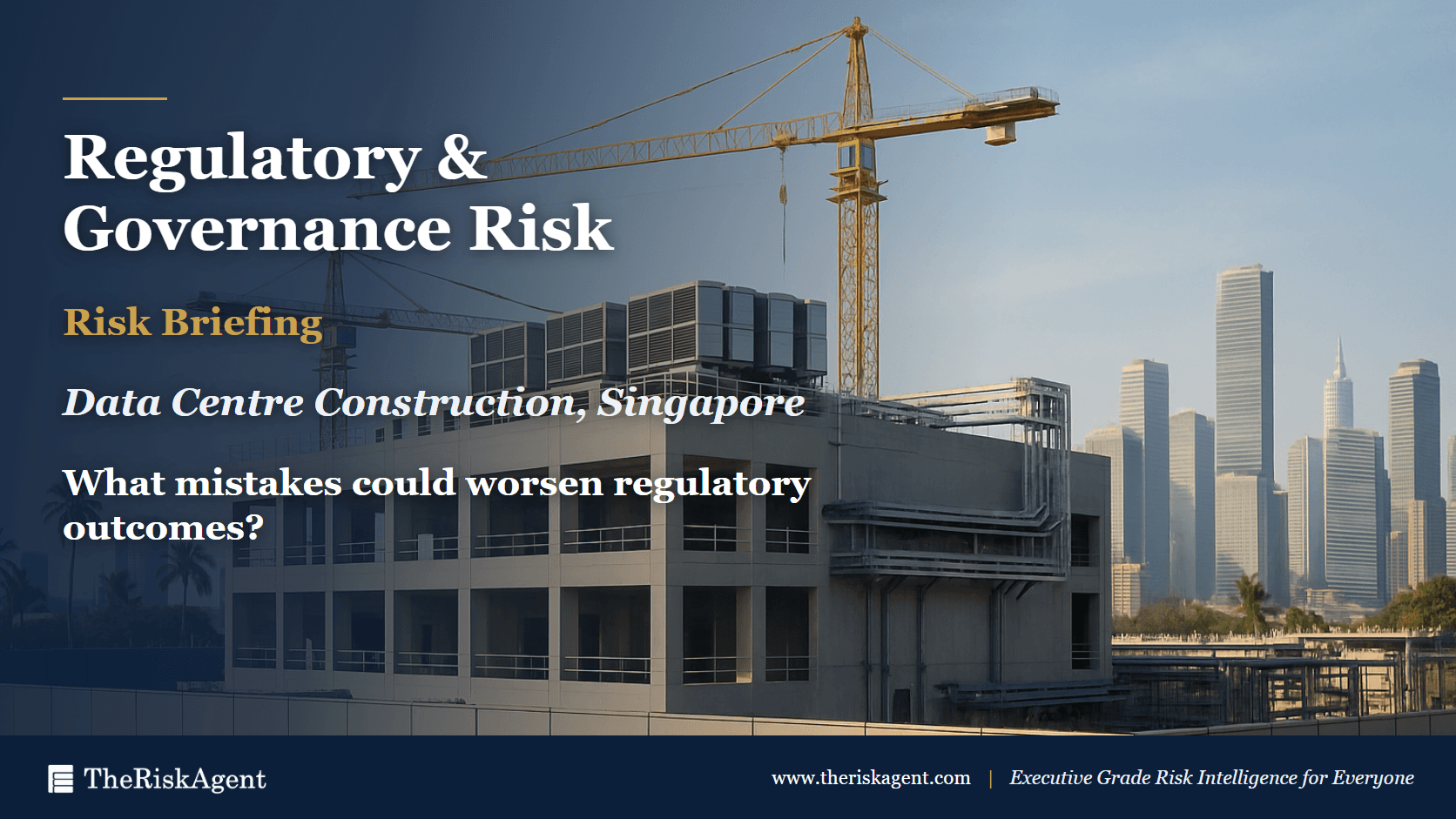

Regulatory and governance risk for firms and individuals building data centres in Singapore, spanning anti-corruption and financial-crime law, workplace-safety enforcement and the incoming statutory licensing regime, assessed as at 17 September 2026.
The instinct on a Singapore construction site is to treat the regulators as gatekeepers. File the submissions, pass the inspections, collect the clearances, and the compliance job is done. It is a reasonable model, and in this jurisdiction it is the expensive one.
Singapore's regulators are not box-tickers. They are active, coordinated and personal: inspectors who arrive unannounced and can halt a site on the spot, an anti-corruption bureau that charges a few hundred dollars with the same seriousness as a large scheme, and a habit of naming directors and managers on the charge sheet rather than only the company.
The deeper point is what they weigh. Across every agency that touches a data-centre build, the outcome turns on conduct after the problem appears at least as much as on the problem itself. The underlying breach is usually survivable. The concealment, the disguised payment, the edited record and the delayed notification are what convert a fine into a prosecution.
So the mistakes that worsen a regulatory outcome here are rarely the failure to file a form. They are the second decisions, taken under schedule pressure, that a data-centre programme is under more pressure than most to take. This is the anatomy of those decisions, and why the cover-up is the crime.
Five mistakes, ranked by how badly they bite
1. Concealing or falsifying, once a problem appears. The single largest multiplier. Amending a safety log, back-dating an inspection, disguising a payment in the ledger or delaying a notification does not hide the original fault; it adds a graver charge on top of it. Falsification of accounts under Penal Code section 477A carries up to ten years, heavier than the bribe it conceals, and obstruction forfeits the cooperation credit Singapore's enforcers explicitly weigh.
2. The facilitation payment treated as harmless. Singapore runs a zero-tolerance corruption regime with no materiality threshold. A payment of a few hundred dollars to smooth a site step is prosecuted, the individual is charged, and once the sum is booked as a legitimate expense the matter crosses into false accounting and often money laundering. The small, quick fix is the classic entry point to a criminal case.
3. A safety lapse during the enforcement surge. Timing sharpens every breach. After a run of site deaths, the labour ministry escalated inspections through mid-2026, lengthened the minimum stop-work order and kept the power to bar a firm from hiring new migrant workers for three months. On a labour-intensive build against a fixed completion date, that is a schedule-breaking sanction, not just a fine.
4. The green claim that cannot survive an audit. Capacity is scarce and allocated against efficiency commitments. Once the new licensing regime commences, an optimistic power-efficiency figure filed to win a licence stops being a marketing target and becomes a representation to the regulator, testable against metered performance and punishable if it fails.
5. Assuming one clearance covers the rest. A data-centre build answers to at least seven agencies at once, plus a new licensing authority on operation. A green light from one is no defence before another, and liability runs down the subcontracting chain to the principal. Treating a subcontractor's bribe or safety failure as someone else's problem is a category error the law does not accept.
The regulator judges your second decision
The organising fact of regulatory risk in Singapore is that enforcers reward candour and self-correction and punish the opposite. The through-line across the anti-corruption bureau, the labour ministry and the incoming data-centre licensing regime is consistent: the breach is one thing, and the response to it is another, usually worse, thing.
The clearest illustration is in the criminal arithmetic. A corruption offence under the Prevention of Corruption Act carries a fine of up to S$100,000 or five years in prison, or both. Falsification of accounts under section 477A of the Penal Code carries up to ten years. So the act of hiding a bribe in the project ledger is punished more heavily than the bribe, and forensic accountants can reconstruct that ledger years later. The disguise, not the payment, is what turns a governance lapse into a custodial case.
The same logic runs through safety and licensing. The incoming regime will require operators to notify the authority of cybersecurity incidents and service disruptions, so a missed or shaded notification becomes the offence in its own right, separate from the incident. On a live site, records altered after an accident convert a safety prosecution into a fraud and obstruction case. In each domain the pattern holds: the cover-up is the crime, and it is a fresh one.
This is why the most damaging mistake is often the reaction to being investigated, not the original conduct. Warning colleagues, deleting messages or aligning accounts after a complaint each add an offence and remove the option of a controlled internal response, because the regulator now treats the organisation as an adversary. The instinct to contain causes the greatest harm.
Buy the full report
Regulatory & Government Risk
What mistakes could worsen regulatory outcomes for me?
Published: 17 September 2026
51 pages
- Country
- Singapore
- Industry
- Data Centre Construction
This published copyUSD 19.99
Buy this reportConfigure this report new at today’s date (USD 49)Zero tolerance, and it is prosecuted small
The sharpest forensic edge on a data-centre build is procurement corruption, and Singapore enforces it against the construction sector as routine, not exception. The tell is the size of the sums. The anti-corruption bureau has charged individuals over a bribe to place a vending machine at a construction site, a case that shows the jurisdiction does not operate a threshold below which a payment is treated as harmless.
The prosecutions have run steadily through 2026. In January nine individuals from construction companies were charged over the bribery of a senior procurement engineer, bundled with account falsification and money-laundering counts. In June four more were charged, including a quantity surveyor and a construction manager at a large contractor. July brought three, and August a further four, three of them company directors and a senior project manager, over town-council contracts, again with laundering charges attached.
Three features of these cases matter for anyone building capacity here. The bribes are often small against the contract, yet they still generate charges. Individuals are charged, not only companies, so directors and project managers carry personal criminal exposure that no indemnity erases. And prosecutors increasingly stack money-laundering counts on top, which widen the sentence and pull in anyone who handled the proceeds. The recurring inducement is procedural: paying to smooth site operations, inspections or payment certification, which is precisely the friction a fast-track programme is under pressure to remove.
The mistake underneath all of it is treating anti-bribery controls as paperwork. A principal that cannot show working due diligence over its subcontractors' payment practices has little to fall back on when a sub-tier bribe surfaces, and in this build type the bribe surfaces several tiers down, where diligence is usually thinnest.
Note. The point is the drumbeat, not any single case. Small procurement bribes on construction sites draw charges through the year, and the individuals are named.
Seven agencies and no single door
Singapore does not run a single data-centre regulator. A build sits inside a web of statutes policed by separate agencies that do not coordinate their penalties, and the fastest way to worsen an outcome is to treat one clearance as if it covers the others. A conventional commercial project answers mainly to the building authority, the planning authority and the labour ministry. A data centre answers to those and, at once, to the land, fire, water and transport agencies, and on operation to a new licensing authority as well.
That density is an amplifier, because a mistake with one agency rarely stays contained to it. A single unauthorised deviation can trigger a stop-work order, and because the agencies clear the build in sequence, one authority's hold idles the others. The building regulator also publishes a live enforcement list against named projects, so a lapse becomes a matter of public record rather than a private warning, feeding directly into the prequalification that hyperscale and government-linked clients apply.
Liability is spread as widely as the agencies. Under the Workplace Safety and Health Act the duty of care reaches beyond the employer to principals, occupiers, designers, manufacturers and suppliers, so almost every party on a project carries defined legal responsibility. A main contractor cannot subcontract the duty away, and a director who assumes the corporate veil will absorb an incident is making one of the more expensive mistakes on offer. In this build type a principal's own licence, migrant-worker quota and reputation are exposed to the acts of firms several tiers below it.
The safety surge on the ground
The most immediate pressure is workplace safety, and it hardened sharply in mid-2026. After seven workers died in five separate incidents over four weeks, the labour ministry called a nationwide safety time-out and ran an enhanced enforcement window from 26 June to 31 July, with fatalities reaching 21 for the year against 18 over the same period a year earlier. Inspectors do not rely on self-declaration; they arrive without warning and can halt a site on the spot.
The measures raised the stakes in ways that read straight onto a construction programme. First-time composition fines rose, the minimum stop-work order doubled from five weeks to eight, and firms in egregious fatal cases can be barred from hiring new migrant workers for three months. For a data centre, a mechanically and electrically intensive build running against a completion date tied to a capacity allocation, an eight-week stoppage does not merely add cost; it can put an allocation milestone at risk, and a three-month hiring freeze starves every workface at once.
The operational error here is to schedule as though enforcement is a tail risk. In the current posture it is a live and frequent event, and schedule pressure is itself the danger: it is what tempts the corner cut on safety or payment integrity that converts a delivery problem into an enforcement one. The composition ceiling for a corporate safety breach reaches S$500,000, but the fine is rarely the largest number. The stopped site and the lost labour are.
Note. The number that triggered the mid-2026 crackdown. A lapse found during an enforcement surge draws a harsher response than the same lapse in a quiet quarter.
When a green claim becomes a legal one
The ground under the sector is shifting from voluntary guidance to statutory duty, and transitions of that kind are where firms carrying old habits get caught. Singapore ran a moratorium on new data centres from 2019, when the sector already drew around 7 per cent of national electricity, and reopened it only through a selective pilot. A recent projection has data centres drawing close to a fifth of national grid capacity in 2026, a higher share than any other country, which is precisely why the state has chosen to license them.
The Digital Infrastructure Bill took its first reading in Parliament on 8 September 2026, with a second reading due at the next sitting, and it creates a licensing authority with powers to grant, suspend or revoke licences and impose financial penalties. Two thresholds define who is caught: one regime covers major co-location and cloud centres with a critical IT load of at least 10 megawatts, and a second licenses every operator at or above 3 megawatts, starting with power-efficiency standards. Of roughly 70 data centres in Singapore, about two-thirds are expected to fall under one or both. Failure to comply can attract penalties of up to S$1 million or 10 per cent of annual Singapore turnover, whichever is higher.
The forensic dimension is easily missed. Efficiency and sustainability claims made to win an allocation or a licence become representations that can later be tested against metered performance. The second capacity call bound selected projects to a demanding power-usage-effectiveness figure at full load and at least half green power. Overstating a facility's green-energy sourcing or its efficiency, or failing to report an incident the authority must be told about, moves the exposure from commercial disappointment into regulatory breach and potential misrepresentation. For a firm commissioning now, the mistake is to design and file against today's voluntary posture when the statutory obligations, and the penalties attached to them, are weeks from crystallising.
| Route | Maximum exposure | Who it reaches |
|---|---|---|
| False accounting (Penal Code s477A) | Up to 10 years' imprisonment | Named individuals |
| Data-centre licence breach (incoming) | S$1 million or 10 per cent of annual Singapore turnover | Licensed operator |
| Corruption (Prevention of Corruption Act s6) | S$100,000 or 5 years, or both | Named individuals |
| Workplace-safety breach (composition) | S$500,000 per corporate breach | Company and responsible individuals |
| Serious safety lapse (administrative) | 8-week stop-work order; 3-month ban on hiring new migrant workers | Whole site, employing firm |
Note. Read the top row first. Falsifying the books to hide a bribe carries a heavier custodial ceiling than the bribe itself. The cover-up is the crime.
The cheapest control is candour
Put the pieces together and the verdict is oddly reassuring for a firm willing to run itself straight. Singapore is not hostile to builders; it is offering scarce, valuable capacity, and its enforcement is predictable rather than politicised. The discretion to overlook a breach is limited, but so is the discretion to punish one arbitrarily. Outcomes are consistent, and they reward the same behaviour every time.
That behaviour is candour and clean documentation. Contemporaneous, tamper-evident records are the single most valuable asset when an inspector arrives. Independent verification of claims against work actually installed catches a billing scheme before an auditor or the bureau does. Preserving records and not interfering the moment a credible allegation surfaces protects an organisation far more than any attempt to manage the narrative. None of this is exotic, and all of it is cheaper than the alternative.
The wider lesson travels well beyond data centres and beyond Singapore. In any tightly regulated environment, the catastrophe is rarely the first mistake. It is the second decision, taken under pressure, to hide the first. So it is worth asking, before the pressure arrives rather than during it: in your own organisation, when something goes wrong, who owns the first hour, what does the record show, and is anyone still rewarded for saying so plainly?
Figures drawn from TheRiskAgent's regulatory and governance risk briefing on data-centre construction in Singapore (September 2026): CPIB and Ministry of Manpower announcements, the Digital Infrastructure Bill and Parliament records, BCA and IMDA material. Produced with AI research tools and reviewed before release. Reference material, not advice. The full analysis is at theriskagent.com.